August 4th, 2026 • 1:29:07
Transcript Note: I have taken the liberty to edit this transcript for clarity and readability purposes. I trust you will find the substance and meaning preserved.
An Interview with Mark Solms by Daniel T. Bourne
Introduction
Daniel T. Bourne:
Doctor Mark Solms, welcome back.
Mark Solms:
Thank you. Great to be here.
Daniel T. Bourne:
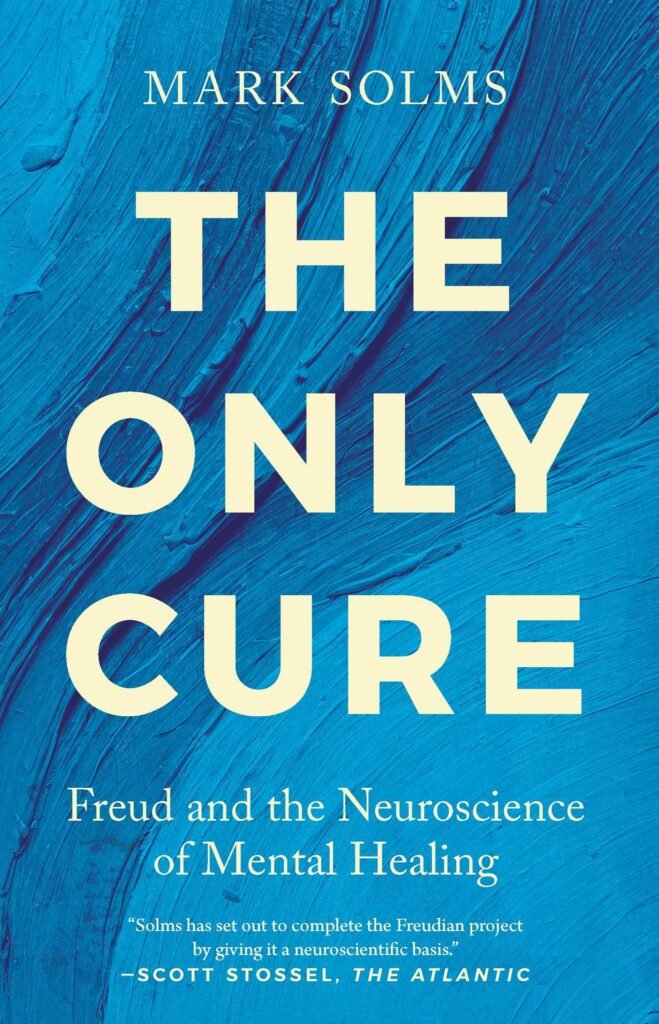
Your most recent book, that’s due to be released in the United States on August 4th, 2026, is titled The Only Cure: Freud and the Neuroscience of Mental Healing. We’re doing this interview a little early, but I’ll be releasing the interview on August 4th. So anyone who’s watching this, head on over wherever books are sold and order your copy today.
But I wanted to start, Professor Solms, by just letting you know that I really enjoyed reading this book. I read it alongside another psychological work, and I didn’t really comprehend much of what the other book said. But in your book, you did a really good job of taking complex neuroscience and difficult-to-understand ideas and putting them in clear language without a whole lot of jargon.
And also I really appreciated that you did a lot of personal narrative. You told some of your own background and history with psychoanalysis and how you came into editing Freud’s work, and that was just a really pleasant read.
Mark Solms:
Thank you. Glad to hear it.
What Makes a Treatment a Cure?
Daniel T. Bourne:
Yeah. So the book title is The Only Cure, and in the book you wrote:
“The talking cure is a cure – and still the only real one we have in psychiatry.”
Can you start by telling us: How do you define cure, and what makes it a cure?
Mark Solms:
The main thing that I’m referring to there is the distinction between a treatment that is directed at the causes of suffering, as opposed to a treatment that is directed at the symptoms.
And I think that it’s a very important point that I think the public need informing about. That, despite the fact that psychopharmacology has all the trappings of proper medicine, you know, physical, scientific, regular medical treatment, not only psychopharmacology, but many other mainstream treatments in psychiatry, like, for example, electroconvulsive therapy, or transcranial magnetic stimulation, or these days even deep brain stimulation.
All of these treatments, despite the trappings of science and the physical nature of the interventions, all of them are aimed at suppressing symptoms. None of them (and obviously I’m generalizing, and there are minor exceptions here and there) but for the very most part, all of them aim at nothing other than suppressing the symptoms.
What’s important about that is a cascade of things. The first and most important is that as soon as the treatment stops, the symptoms come back because the treatment has not done anything about what’s producing, what’s causing, the symptoms.
Secondly, they’re not that effective. So when I say they suppress the symptoms, I think that’s a little optimistic. They aim at suppressing the symptoms, and they do so partially. There’s variability across different disorders and across different individuals, but they don’t remove the symptoms.
Then they also come with side effects. And as we’ve learned over the years – I emphasize this because it’s only in the practice that these drugs and other physical treatments have been used for such long periods that they were never designed for – they were never intended… When they were first tested for safety and efficacy, they were acute interventions. But using them over months and years, and frankly, in some instances, not a few instances, decades, there are a whole lot of other side effects, and some of them permanent side effects and withdrawal effects, all of which have come as a rather disappointing surprise.
So the main thing I say, again, in terms of this cascade: The first and most important thing is that they suppress symptoms, and therefore when you stop the treatment, the symptoms come back.
Then there’s the fact that they don’t suppress them completely, that they come with side effects, some of them enduring side effects and withdrawal effects.
So surely the alternative is better. In other words, a treatment that aims at treating the cause. When you treat the cause, if you do so successfully, then you ameliorate symptoms permanently. And when you stop the treatment, the symptomatic improvement persists.
And very interestingly (I don’t know how much detail we’re going to go into, but if we get there) very interestingly, in the case of psychoanalytic therapy, there is not only a maintenance of symptom relief, there’s actually ongoing improvement. In other words, the patient continues to get more better after the end of the treatment, which is as sure a sign of having received a causal treatment as there can be. In other words, the effect of the treatment clearly persists. Something has changed within the person; the mechanism continues to be active after the end of the treatment.
So I mentioned how the physical psychiatric treatments, pharmacological and otherwise, the fact that they have all the trappings of science is rather important to point out. That despite all of that appearance of proper medicine, actually this apparently fluffy business of just talking to another person (which seems very unlikely to actually be the more effective and, more mechanistically speaking, more curative, curative in the causal sense of the word, of getting at the cause of the ailment): talk therapy is better.
And this is not just an opinion. Fortunately, it’s something that can be demonstrated by a great deal of evidence.
There’s a very large body of randomized controlled clinical trials being conducted in the case of psychotherapy in general since the ’70s and ’80s. In the case of psychoanalytical therapy, much to their own detriment (it’s their own fault, the psychoanalytical therapists came to the game of testing their treatments a little late in the day). But since the ’90s, they’ve been in the game, and there’s a very big evidence base that these are highly effective treatments and that the therapeutic benefit is an enduring one.
Psychopharmacology and Defense
Daniel T. Bourne:
Yeah. You put even in the [book], with psychiatric drugs and medications, they’re not merely symptomatic treatments, but can even be conceptualized as a defense against disorders of emotion.
You wrote:
“I drew attention … to the fact that the artificial suppression of feelings like panic and despair by self-administered narcotics is a ‘defence’ mechanism. So let’s put it bluntly. The mainstay of modern psychiatry – psychopharmacology – is for the most part a defense against facing the facts about what our patients really need. It is a way of suppressing symptoms instead of asking what they mean and fixing that.”
Mark Solms:
Yes, and I’m aware that that’s quite a strong statement, and I very deliberately made that statement.
Just for people to understand where I’m coming from, as you just read there, it’s very easy for people to understand that drugs of abuse are defensive. In other words, rather than actually changing your life, rather than tackling what’s actually gone wrong for you in the living of your life, which requires hard work. And when I say hard work, I mean time and effort, but also emotional difficulty: to face up to unwelcome facts, to face up to those aspects of yourself that you’re least proud of and least managing. It’s not welcome. It’s not something that one does if one has an alternative.
And for many people, the alternative is, well, let’s just smoke dope, or let’s just take opiates, or let’s just drink ourselves into oblivion. It’s clearly defensive in those cases.
So what is it fundamentally that makes a difference between self-administration of a drug which makes you feel better but doesn’t actually change your life, and the medical prescription of a drug which does the same thing? It makes you feel better, but doesn’t change your life.
I think obviously the intention behind the psychiatric treatment is much more noble. I think that most psychiatrists, the very large bulk of psychiatrists, really do think that what they’re delivering is the best evidence-based treatment that there is. I don’t think that they think they’re fudging things.
But there are very important forces at work behind the scenes, not least of it, you know, the industry. The pharmacological industry, it’s a multibillion-dollar industry with massive marketing wings, unlike psychotherapy and psychoanalysis, where there are just people pottering around in their private practices, usually on a fairly individual basis. These are not vast organizations, certainly not vast corporations behind them.
And then there’s the healthcare industry too. The healthcare industry in the sense of healthcare providers. If you can provide cheap and brief treatments and get away with it, obviously you would choose to do that.
So these kinds of things are going on behind the scenes. So I really do think it’s a defense, although I think that the responsibility ultimately rests with patients.
You know, it’s patients who buy into this narrative because it suits their wish to believe that it’s possible to get quick and easy solutions rather than the much more difficult path that leads to real change.
Emotional Needs and the Origins of Psychopathology
Daniel T. Bourne:
Yeah. I worked somewhere in the substance use department. And when the patients would come to therapy, we did therapy and group therapy with them, they often said, “I need to find new coping skills.” They had probably been through there before, and we kind of hammered coping skills, as in, like, they lack coping skills, so they’re turning to drugs or alcohol.
And I would talk… I have been reading some of your work and other psychoanalytic work, about how emotion is at the center, affect, and that we have all of these defenses that we deploy against the affect, the overwhelming emotion.
And so I would talk amongst other psychologists about, you know, our thoughts and retraining our thoughts and cognitive reframing, that’s all in the effort to cope with our emotions.
And it’s not that emotions come from thoughts, but… it just makes so much more sense when you think about it meeting emotional needs. And even patients, I think, have that same language when they come to therapy.
You even say in the book, like, we treat emotional needs, and most mental health disorders are disorders of emotion, or emotions that have gone unmet.
You say:
“Embedded within an emotional disorder is the patient’s (unconscious) attempt to bring something about – specifically, to meet an emotional need.”
And you talk about the drives. You say:
“When it comes to feelings (which are, never forget, conscious things), what you see is what you get. The psychoanalyst’s initial task is not analysis, then, but classification.”
Can you talk a little bit about emotional disorders, classifying them, and how you go about that?
Mark Solms:
Yes. I’ll gladly do that.
I think that it’s really, despite appearances, remarkably simple. So I consider it a virtue, when it comes to the complexities of the life of the mind, to be able to say something clear and simple about it, because it’s so easy to get lost in the thickets of it all.
I mean, there’s a great deal of complexity that one can get lost in and lose sight of this sort of simple big picture.
So the simple big picture is this: Let’s start with bodily needs. It’s easy for people to understand that we living organisms – all living organisms, us human beings included, whatever else we are, Homo sapiens is a species of organism – we have needs.
You have to eat certain nutritional substances, a range of them. If you don’t, you die. You have to drink – water in particular. If you don’t, you’ll die. You need to breathe. You need to maintain a certain balance between the oxygen and the carbon dioxide levels in your blood. You need to sleep. You need to urinate, you need to et cetera, et cetera.
So this is what I mean by needs.
Now, when I said if you don’t meet those needs, you will die, actually there’s an intermediate period, which is when you will feel great distress of a particular kind.
You will feel thirst, you will feel hunger, you will feel sleepiness, you will feel pain, et cetera.
These are feelings. Even though we’re talking about bodily processes, this is the place that feelings occupy in biology.
They tell the organism: This need is not being met.
And when I say feelings tell us that a need is not being met, I’m speaking about negative feelings. Positive feelings tell you the opposite.
So, … The very reason that feelings exist is so that you know whether a need is being met or not, and which need is being not met in the case of negative feelings.
That’s what feelings are.
Please note, it’s not something fluffy, you know, it’s not something in the ether. This is pretty darned important. This is how organisms know whether what they’re doing is working or not, and it enables them to change their minds, to do something differently, if things are not working out as expected.
Now, the very same thing applies to emotional needs.
This might appear to be a leap, but it’s not. This is how it works.
Let me take some examples which people will easily recognize as emotions. Let’s start with FEAR.
FEAR, although it’s clearly an emotion, what does it actually mean?
In the same way that thirst means that you are not where you need to be in terms of a bodily need, and so does hunger, and so does sleepiness, FEAR means you are not where you need to be, which is safe.
This is clearly of some biological importance. The reason that we feel FEAR is so that we know: I’m currently in a dangerous situation. Where I need to be is safe, and where I am now is not.
Likewise, let’s say separation distress, because we mammals cannot look after ourselves when we’re little. This applies across the board when it comes to mammals.
So we have to attach to a caregiver. If we don’t find somebody who will reliably look after us, we’re going to die.
And so we feel panicky anxieties when we are separated from our caregivers, and we feel deep despair when we are permanently separated from a caregiver.
So these feelings of panicky separation distress, or deep depressed despair, these feelings mean something. They mean that you do not have available to you the loving, caring ministrations of what we call an attachment figure.
And so those sorts of feelings, again, clearly emotional ones, they just tell you that you’re not meeting a very important biological need, which just happens to be called an emotional one.
Needs in relation to other people:
We need to not be endangered by other people. We need to be cared for and cared about by other people.
I’ll give just one further example, which is RAGE.
And again, clearly it’s an emotion. Where does that fit into the biology of it all?
Well, what causes you to feel anger… Let’s go down a notch… What causes you to feel irritation is if there’s something getting in your way, something preventing you from getting what you need, something standing between you and something that you need.
This frustrating, impeding obstacle is the object of your frustration, irritation, anger, and eventually rage.
And the biology of it is clear. If you can’t stand up for yourself, fight for your place and your fair share, you’re going to cop it. You know, you need to be able to do that.
You need to get rid of things that are preventing you from getting what you need.
So emotional distress is just the same as bodily distress.
And when it comes down to the neural mechanisms of it, we understand that very well. It’s called homeostasis.
Homeostasis is just a very simple mechanism which you have a set point: This is where I need to be. I need to not have frustrating, impeding things in my way. Whoops, I do have them. Then I feel something (namely, the feelings I’ve just been talking about. These angry, frustrated, irritable sort of feelings.
So when our patients… let me put it like this: these are the really simple parts. I think everything I’ve said is simple, but let me now distill it to the simplest of things.
During childhood, we have to learn how to meet our emotional needs. And that is the singular task of mental development. It’s learning how to meet your emotional needs.
Now, the bad news is it’s difficult.
It’s difficult because emotional needs differ from bodily needs in that, for the most part, they are needs in relation to other people.
So, you know, hunger, the need for food: there’s the apple. The apple’s just sitting there, you take it. You know, there’s the water, you drink it. There’s the air, you breathe it. They are inert things that just wait for you to imbibe them.
Other people have needs of their own.
It’s therefore much, much more difficult to learn how to get other people to behave the way that you need them to behave in relation to yourself.
To put it in a slightly technical way, other human beings are less predictable than are inert objects. So it’s harder to predict what will work and what will not work in relation to these needs of mine, and what will work with this person as opposed to that person, what will work in this situation as opposed to that situation.
So mental development, when I say it’s simply learning how to meet your emotional needs, it’s learning a great deal.
The other problem that makes it difficult is that these needs conflict with each other.
So, for example, I said we need to keep our caregiving figures (usually a maternal figure or some other parental figure) nurturing us, caring for us, looking after us. We want to keep them available, close at hand, forever and always, on the one hand. That’s one need.
Then there’s another need, which I’ve also just mentioned, namely to get rid of frustrating, impeding obstacles.
Now, whose mother never frustrated them? You know, whose parents never impeded them?
So you get pissed off at your parents. But you can’t attack them. You need them.
And not only can you not attack them because you need them, you need their love. You also can’t attack them because they’re bigger than you.
So there you have a conflict between your RAGE (your aggressive needs), and your attachment needs, and your FEAR (your safety needs).
There’s a wonderful example of the kinds of conflicts that we get ourselves into.
And I will add to that: You notice I’ve spoken of parents and of childhood, which is the critical period when we have to learn the foundations of how we’re going to go about these enormously important tasks in life.
Well, the quality of your parents is going to determine a great deal of what goes on there.
And when I say the quality of the parenting, I don’t mean it in an exclusively or especially judgmental sense. I mean, you know, it’s no surprise, it’s no accident that poverty comes with mental health problems.
Parents who are hard-pressed, who are at work all day, who have struggles of their own, who don’t have support networks, who don’t have the finances, who can’t live in nice, spacious, comfortable environments and safe ones – you know, it’s harder.
So it’s harder for them, and it’s harder for them to provide for their children. And so it’s harder for the children to learn how to meet their emotional needs.
So, you know, it’s really very difficult. It’s a difficult business.
But that’s it. The great task of mental development is learning how to meet your emotional needs.
At a stage of life when you are vulnerable, dependent, ignorant of the ways of the world, physically incapable of meeting your own needs. But nevertheless, you know, that’s when you’ve got to do it.
So it’s not surprising that some of us come up with less-than-ideal strategies about how to go about it.
There’s a process in the brain, a memory process called consolidation, which is a big word for a very simple process, which simply means that when you try something once, it’s not very deeply consolidated. In other words, it’s a fragile kind of temporary solution.
If you try it again and again and again, the ones that work are the ones that become automatized.
Everybody knows this. Think about walking, talking, riding a bike, playing a musical instrument, et cetera, playing tennis or whatever.
As you repeat an action, a policy, a way of going about doing things, so it becomes second nature. And that’s the process of consolidation.
The important part of it is that over time these things become automatized.
Automatized means no longer under conscious control.
And we do that with our emotional needs as much as we do it with anything else.
To the extent that you cannot find workable solutions, to that extent you’re going to suffer from feelings. And that’s the heart of psychopathology, the keynote of every psychiatric disorder, is affect, the term that you used earlier.
Our patients suffer mainly from feelings. This is the centerpiece of what psychiatric disorders are all about.
And when you said, in your quoting me there, that the first task of the clinician is not to analyze so much as to classify, I mean the quality of the feeling, the type of emotional distress that the patient suffers, tells us which one of their emotional needs is not being met.
And it is literally as simple as that.
If somebody is suffering from a certain emotion, it means there’s a need there that’s not being met.
Why? Well, for the very most part, it’s because the strategy you came up with during your development, through no fault of your own… you did the best you could.
Let’s say you came up with the least-bad solution you could come up with.
It doesn’t mean it’s an ideal solution. It doesn’t even mean that it’s a terribly good solution at all, but it’s the best you could manage in the circumstances you found yourself in.
That’s the cause of psychopathology.
Remember what we were talking about at the beginning about causes as opposed to symptoms. Well, there you see it.
The cause is: How am I – how is this person – going about meeting their emotional needs? The ones that they’re not going about meeting very successfully, for whatever reason. As I say, there’s all sorts of complexities that get into that. But the simple fact is that to the extent that you have not learned how to meet an emotional need, to that extent you’re going to suffer from that feeling.
The feeling is the symptom. How you’re going about meeting that emotional need is the cause.
And so there we have… I can now conclude this long monologue… the second simple thing I can say.
Which is that, given everything that I’ve said, the purpose of psychotherapy is to help our patients to find better ways of meeting their emotional needs.
Simple as that.
That’s what psychotherapy is. And again, I say I’m not embarrassed to be so simplistic about it. It’s not overly simple. It is the sort of centerpiece of what we’re doing.
And it’s good to be clear about what it is we’re doing.
We are helping our patients, in adulthood to… it’s a kind of a reparenting process. It’s a sort of second chance at readdressing.
The first thing you’ve got to do is become aware of, well, how am I going about doing it?
Because remember, these things are automatized.
So the technique of our treatment aims at helping the patient to become aware of how they’re going about meeting their emotional needs, where it came from helps them to understand why they’re doing that, and also helps them to sort of sympathize with themselves, as it were.
You know, “This was… yeah, I can see why I’m doing this. It’s the best I could do, given the way things were.”
But things are not like that anymore. You’re not a child anymore. You can now… you’re now in a very different position and much better placed to be able to, second time round, find a better way of meeting your emotional needs.
And that’s what we do in psychotherapy.
So, as simple and ordinary as all of this might sound, that’s how we cure mental suffering. It’s by helping our patients to find better ways of meeting the emotional needs that they’re suffering from.
Now, that doesn’t mean there’s no place for symptomatic treatment. I need to emphasize this because, you know, I don’t want people to throw away all their pills, and I also don’t want people to think I’m some kind of anti-pharmacological fundamentalist.
There is an important place for symptomatic treatment.
For example, people can have crises. Crises can pass, and bad things can happen, and traumatic things can happen at any time in life.
And to be helped through those things, it’s of course a very valuable possibility to be symptomatically, palliatively supported in times like that.
There are also medical crises in psychiatry. There are people, for example, who feel suicidal. You can’t say, “Well, you know, come into therapy. I’m sure in a good few months you’ll start feeling better.” The patient might not be around in a good few months.
So there you need symptomatic treatment.
And likewise, not unusually, there are patients who are so depressed that they just can’t find the energy, or for that matter, the belief, the optimism, the hope that motivates them to go through the hard work of psychotherapy.
So symptomatic treatment to help you get yourself together sufficiently to be able to engage in and use psychotherapy. Symptomatic treatments are useful for that too.
And I haven’t exhausted the possibilities, but I think I’ve now spoken rather too much.
So over to you.
Defenses and Meeting Emotional Needs
Daniel T. Bourne:
Yeah, no, thank you. That was… there’s so much there that brings up a lot of questions.
One question I had in that is, I’ve heard of even things like rationalization and justification that can be defenses.
And when you think about meeting an emotional need, how do you know if you’re actually meeting the need, or if you’re just employing another defense against it?
Mark Solms:
Yeah. Philosophically speaking, that might sound rather complicated, but in reality it’s not complicated.
It comes down actually to what we were discussing earlier about psychopharmacology.
The easiest way to tell whether what you’ve done is defensive or not – in other words, whether what you’ve done is avoided the problem as opposed to addressing the problem – is that when the method that you’re using to avoid the problem is withdrawn, the problem comes back.
So defenses work like that.
You come home stressed beyond measure, and so you open the whiskey and you drink yourself into a stupor and you feel much better. The stress is gone and life is rather blissful.
But you wake up the next morning, first of all you have the side effects, and secondly, all the things that are stressing you are back again. They haven’t been removed by the binge.
The same with other kinds of binging, like eating and so on, which is really very commonplace.
So this is how defenses work. They are an exercise in avoidance. They are ways of getting rid of the feeling (in other words, the symptom) without addressing the cause, the thing that’s producing the feeling.
And so that’s just how defenses work.
The illusion in the short term that you’ve made things better by getting rid of the feeling is exposed by the fact that as soon as you stop doing whatever it is you’re doing defensively, the feeling returns because the underlying need is not being met.
Conflicting Emotional Needs
Daniel T. Bourne:
Yeah. I was thinking, I guess maybe an example. Let’s say that you are struggling in your marriage and you think about leaving, but then let’s say that you tell yourself, “Well, it’ll be better for everybody if I stay.”
And you start to really believe that, and it’s like the wise thing to do, or it’s the appropriate thing to do, or whatever. And believing that helps you stay, and it makes the symptoms kind of at least either subside, or you’re not aware of them anymore.
How do you know if that’s a defense, or if that’s, I guess if that’s not meeting the emotional need?
Do you know where I’m coming from?
Mark Solms:
Yes, certainly.
And I think that, on the one hand, you’ve used a very commonplace example, and on the other hand, you’ve illustrated how complex these things are.
And I remember what I said at the beginning, or near the beginning, of our conversation. I said this business of learning how to meet your emotional needs is not easy.
It’s not easy because you’re dealing with other people who have needs of their own, and because you have multiple emotional needs.
So the situation you just described is one in which many different needs conflict with each other.
I mean, I’m sort of fleshing out the story that you’ve told, but it may be: My partner is frustrating me. That’s, you know, they’re standing in my way, they’re preventing me from getting what I need. So they irritate me.
But on the other hand, they evidently love me. Not many other people seem to want to put up with me and have me around, you know, so I stick with the devil I know, even though, still, she frustrates me.
Then you might have children with that partner.
And if the frustration is greater than the attachment need, then you start to say, “Well, you know, I’d rather sacrifice this attachment, with all of the uncertainty that comes with that. I might or I might not find somebody else, somebody better, but I just can’t put up with this person anymore. So I’m out of here.”
But if you have children, then you have another need, not one that I’ve mentioned yet, which is called CARE: nurturance.
You know, we mammals, I told you, we need to be looked after. And luckily, the mammals that we need to look after us have a need to look after vulnerable dependents.
So there you have another conflict.
I’ve just mentioned three there, three conflicting needs, in the scenario you’ve just described.
There are plenty of others.
There are… For example, another emotional need which comes as a surprise to many people. It’s called SEEKING, which is a need for novelty.
We all of us have that. It’s why we go to new places and do new things and explore interesting topics and read books and go to the cinema and do courses.
It’s because we have a need to know, a need to understand, and it makes us attracted to things which are novel.
So back to your relationship situation: I need this person to love me forever and always, but what else is available? That’s a common problem when it comes to relationships.
Daniel T. Bourne:
Mm-hmm.
Mark Solms:
There’s another emotional need.
I’m taking the opportunity just to get some, you know, to put some flesh on the bones of this abstract concept of emotional need.
And by the way, it’s important for our listeners to understand that I’m not plucking this stuff out of the air. I mean, this is the product of decades of research in affective neuroscience into what are the basic needs and emotional needs of us mammals, and Homo sapiens included.
So this is knowledge that I’m imparting. It’s not a philosophy.
Another need, remarkably, another need of the human being and of all mammals, is to PLAY.
We need to play.
If you look in the park, you’ll see not only the kids doing this rough-and-tumble thing, but the dogs are doing it at the same time.
And so, not to put too much detail into this, but one of the bottom lines of our findings in terms of researching why we need to play, what is this for, is it’s got to do with learning how to negotiate power relations.
Who’s the winner? Who’s the loser? Who’s dominant? Who’s submissive? Who’s the top dog? Who’s got the status? Who’s the jock and who’s the nerd? Who’s in and who’s out? Who’s cool and who’s not?
All of this sort of stuff.
If you think back to childhood, as much as we idealize PLAY, it’s a bloody serious business.
Do they want to play with me or not? Am I chosen or am I excluded? Et cetera.
So one of the ways in which this all cashes out in relationships is that there is power struggle. There is cooperation and collaboration, or the lack of it. Reciprocity and mutuality, or the lack of it.
Whose needs are going to take priority over whose? Who’s going to dominate, in a word?
So all of these things come into the question of whether a relationship is working or not.
So it’s not surprising, as you started articulating your example, that you started thinking, “Well, gosh, isn’t… this is not a simple question I’m asking Mark Solms?”
I hope you could use this in order to illustrate the point.
And I think the main point that you’re illustrating is the one that I’m emphasizing, which is that it’s hard to learn how to meet your emotional needs because they are needs in relation to other people who have needs of their own, and because they conflict with each other.
And so the answer as to “Should I stay or should I go?” when it comes to a relationship is not something I think people can necessarily decide for themselves.
And guess where I’m heading with this?
This is one of the reasons why we have psychotherapists.
You know, this is a discipline that’s been going for more than a century now, where we’ve learned through long experience in a wide range of situations, in real lives.
Fortunately, the bad news, as I said, is that it’s very difficult to learn how to meet all your emotional needs.
The good news is your emotional needs are no different from everybody else’s.
So wherever you find yourself, guess what? Many, many, many other people have been there before you.
And so we’ve accumulated a body of knowledge as to how best to tackle these difficulties of life.
And that’s what psychotherapy is.
And when I say psychotherapy, I mean it in the broadest sense of the word.
In other words, sometimes you need a consultation with a therapist. Sometimes you need five. Sometimes you need, I’m sorry to say, months and years. It depends.
Not all of life’s difficulties are, as much as they may seem impossible to us because we’re in the thick of it, and because, remember, our own ways of going about dealing with our emotional needs are, for the very most part, not transparent to us.
They become automatized.
We don’t even know that we’re doing it because it’s not we who are doing it; it’s just happening. It’s just automatic.
Like, as I said earlier, the way that you… you don’t think, “While you’re speaking, shall I use an adverb or an adjective here? Shall I use the first-person pronoun or not?” It’s just, you know, you just do it.
And this is what we do in all of our psychological life.
So to get the help of a professional who knows a thing or two about all of this is the way to deal with conflicts of the kind that you’ve described.
And I need to tell you one other thing while I’m at it.
You might have noticed, I said earlier, that the task of psychotherapy is to help our patients find better ways of meeting their emotional needs.
I use the words help our patients find better ways. I use that phrase deliberately.
It doesn’t mean that we teach our patients better ways.
There’s some psychotherapies (I don’t mean to say they’re better or worse) there’s some psychotherapies which do involve teaching our patients techniques, better ways of going about meeting them.
And there are other types of psychotherapy where it’s a matter of just making the patient aware: “You’re doing this automatically and compulsively. Do you know that? Now that you know that, you’ve got the choice to carry on doing that, or maybe you might come up with a better way of dealing with that.”
That’s not the therapist teaching you so much as the therapist helping to give you choice, to decide for yourself how you want to make yourself more deliberative, more conscious, where you’re in voluntary control of your life rather than things happening automatically.
So when I said the one is not better than the other, some people want to be told what to do. Other people can’t stand it.
And some sorts of problems, it’s a no-brainer what to do.
So why not spit it out and say, “Hey, you know, this tends to work and that doesn’t,” whereas other of life’s problems, like the kind of thing we’ve just been discussing in terms of long-term relationships, there’s no one-size-fits-all.
It’s complicated and it’s individualized.
And there again, we have a very important thing about this field that we’re talking about.
It’s individualized.
As much as there are general principles that apply to all of us, the brain is different from any other organ in that it is specialized for being individualized.
It adjusts and adapts to the particular environmental niche that you find yourself in.
And so each of us ultimately comes up with our own personal, individual, subjective solution to things, albeit constrained by the general principles governing this organism that we are.
And so the solutions that we come to… this is the point I’m leading up to… the solutions that we come to need to be individualized.
So the idea that this pill will cure it for everybody is ludicrous considering the way that the brain works.
The brain… each of us has our very own brain organization, and so each of us has our very own life’s problems which need tailor-made solutions.
Mourning, Loss, and Finding New Ways to Meet Our Needs
Daniel T. Bourne:
Yeah. That was really helpful in talking through. I think sometimes, like in the situation that I gave that you so well fleshed out, I think sometimes it can feel like I’m responsible to this person or I’m responsible to this person.
And it feels like we are choosing one responsibility over another, or we’re choosing duty over freedom or something like that.
But the way that you fleshed it out there, it was, well, you’ve got seven primary emotional needs, and a lot of them are conflicting with one another.
It’s almost like a prioritization at some point of which emotional need I’m going to meet now.
I’ve heard of the importance of mourning in therapy, like maybe mourning a lost attachment figure or mourning something that you needed, an emotional need that you never got met, and that seemingly being a way to kind of meet that need or bring it to awareness.
And I’m going to try to tie it… I’m throwing a lot out to you, but when it comes to emotional needs and something like you talked about, where “You’re doing this thing. Can you see that you’re doing this thing in order to meet this emotional need? Now that you know that, can we do something else? Can we learn something else?”
I think sometimes I wonder, like Freud, for instance, or Carl Jung, they both smoked a lot of cigars and pipes and had a hard time quitting, even when doctors would say, “This is leading to bad results.”
If it was like, if something like that… one example would be, “I just really like the cigar. I like the way it affects me, and that’s the only reason that I do this,” versus “Can you see that this is meeting an emotional need? And can we find another way to get that emotional need met?”
Even things like that, where perhaps you’re putting a substance in which is changing things, and then you want that substance again, would you say that that’s also meeting an emotional need, and that if they just knew maybe that that’s what they were doing and they wanted to find another way to meet that emotional need, that that would help them no longer do that anymore?
Mark Solms:
So I think you’ve touched on a number of things there, but let me just pick up on the one that you landed on at the end.
It’s, you know, we’re speaking a very loose psychological language when I speak about emotional needs and all of that. And I do that on purpose.
I want it to be something we should all be able to relate to. We experience our emotional needs. We know what I’m talking about. All of our lives are about this.
It’s about: I want to feel better and I want to avoid feeling worse.
Everything that we do is for that end. That’s what it’s all about.
But as I said, what we know about these emotional needs now in the 21st century is hard science.
I mean, we really have learned a great deal about what the underlying basic emotional needs of the human animal are. And this is powerful knowledge.
I say the basic emotional needs of the human animal.
Where are these needs expressed physiologically? It’s in our brains.
And the chemistries that psychiatrists tinker with are the chemistries of the circuitry of these basic emotional and bodily needs that we spoke about earlier.
So there is a seamless body of knowledge that starts, on the one hand, in the business of lived experience, ordinary life experience, and at the other end, you know, it comes down to molecular biological mechanisms.
So psychopharmacologists who are tinkering with these emotional feelings, they do so chemically.
I said also, for example, even deep brain stimulation. They’re literally putting electrodes into these circuits.
And so the substances that you spoke of there, they are doing the same thing. And different substances do different things.
Like, for example, opiates, which are a very common drug of abuse, ameliorate separation distress because the attachment circuitry of the mammalian brain is mediated by opioids, mu-opioids in particular.
And people also take opiates for pain.
Well, separation distress is an emotional kind of pain. It’s a mental pain. These two circuits are very closely related to each other.
So somebody who’s abusing opiates is trying to make that kind of distress feel better.
Somebody who’s abusing methamphetamine or cocaine – this is a dopamine circuit.
What I was talking about earlier in terms of that curiosity, interest, expectancy, that kind of positive engagement, optimistic engagement with the world, a depletion in relation to meeting that need is ameliorated by these kinds of drugs.
And not all of the drugs have a one-to-one relationship with these different need systems.
Some of them sort of cut across them, like, for example, acetylcholine, which is another brain chemical.
What it does is it improves signal over noise. So it helps you to sort of focus and not be distracted by all the fuzz.
And cigarettes, tobacco, acts through nicotinic receptors; it enhances your acetylcholine.
So you’re sharper, you know. And that is in relation to all your emotional needs. So your attempts to “What shall I do here?” are focused by smoking tobacco.
Whatever the need is, whether it be, “How do I deal with this danger?” or “How do I deal with this sadness?”, it does the same thing.
But these things, as I said earlier, come with side effects and withdrawal effects, et cetera.
In the case of this particular substance, it killed the man behind you [points to a portrait of Sigmund Freud]. He died of cancer of the jaw.
So, you know, it’s better to find non-pharmacological ways, as I said, to deal with these things.
Now, I said you touched on a number of topics, and I said I would just alight on the last of them. But at the first of them, you said something terribly important, which I don’t want to lose.
You spoke about the importance of mourning.
And I said earlier that in separation distress, when a mammal who’s attached to another mammal (and remember we’re mammals) when you become separated, firstly you have this what Bowlby called protest.
“Mummy, you lost me. Where are you?”
You search, you cry, and you search.
And that’s followed by what Bowlby called despair.
And by the way, Bowlby was a psychoanalyst, but he was also a kind of ethologist. In other words, a student of animal behavior, except the species he studied was us.
But this separation distress cascade, of going from protest to despair, it happens across the board with all mammals.
The despair phase is: I’m not separated and trying to find my lost attachment figure. I have lost them.
It’s not separation, it’s loss.
And you slump and you give up. That’s what all mammals do.
Now that’s a horrible feeling.
It’s followed by the mourning that you’ve just spoken of.
So if all you did was give up, then you have depression.
You know, what you have to do is say, “Okay, that I’ve lost.”
You have to go through the painful process of detaching yourself from something you were attached to, so that you can reattach to something new.
And so, you know, it’s true, it’s right to be hopeless about ever getting back somebody who’s dead, for example, but it doesn’t mean that you can never replace that person with somebody else who’s equally loving and supportive and so on, or able in a new way to provide you with satisfaction of those needs.
And in order to do that, the work of mourning is necessary.
And that’s just the same thing that I was saying about finding better ways of meeting your emotional needs.
So one way is, “I’m giving up.”
Another way is, “Okay, I’ve lost her, but life is still worth living. Let me find something else, someone else.”
That’s why mourning is important.
It’s an example of the bigger process that I was calling ‘finding better ways of meeting your emotional needs.’
Neuroscience and the Subjective Mind
Daniel T. Bourne:
That’s all very helpful. Thank you.
And I really appreciated… a lot of what you just said, well, all of it, I think, most of it is in this book.
And I didn’t know about how opiates act on the same emotional center of the brain that attachment is focused on, and that was kind of mind-blowing to me.
And on that point, the subtitle of this book is Freud and the Neuroscience of Mental Healing.
Maybe, you’ll probably goff at this – I don’t know if that’s the right word [I meant scoff] – but when I was going through school, I was primarily interested in the subjective experience and the psychic experience.
So if I’m seeing somebody and they talk about how they love speeding down the road on their motorcycle, I’m not too concerned with whether that’s adrenaline or dopamine or whatever that is.
And we were having classes on neuroscience and they were talking about, “Yeah, when this happens, that’s the endocrine system,” or that’s [this or that]. And I was kind of like, “How is this going to help me work with my clients? Or what does this tell me? Does this tell me anything new?”
Like, me being able to tell my client, “Yeah, that’s a dopamine spike, and we just need to…” That, to me, seemed a little bit unhelpful.
If you read literature, I don’t know how much it adds to literature by talking about what the brain is doing.
That was kind of my thought process.
But reading this book, I really appreciated all of the neuroscience in here.
So one of my questions leading into this was: What does an understanding of the brain, or neuropsychology, neuroscience, what does that teach us about psychology?
Mark Solms:
Thank you.
Let me start by agreeing with you, with your younger self’s (well, not that you’re old now), but your student self.
I think your student self was right that to say, “This feeling that you’re experiencing is actually a dopamine spike,” is not to add anything.
And so I want to just explain why that is the case, first of all.
And I’ll start out by putting it like this. It might seem as if I’ve digressed, but bear with me.
When I wake up in the morning with my eyes closed, I feel myself to exist. And I think, “I’m Mark Solms. I’m still alive, thank God for that.”
That’s my mind. Okay? It’s me, my mind, I’m experiencing it.
I then stagger out of bed to the bathroom and I see in the mirror this body.
And with my eyes… the other one I was feeling with, with my mind… now with my eyes I see this physical body, and I say, “That’s Mark Solms. He’s alive, thank God for that. He still exists.”
These are just two different ways of observing the same thing.
Okay? There’s not two Mark Solms.
There’s Mark Solms’s body and there’s Mark Solms’s mind, and they are two appearances of the same thing.
Those two appearances, let me put it like this: It’s the same thing observed from two different observational perspectives, two different points of view.
The being of Mark Solms, observing inwards, and the body of Mark Solms, observed outwards, are two appearances of the same thing.
So to come back to your intuition as a student, it doesn’t actually add anything to say that feeling is actually dopamine.
It’s just saying, yeah, so you can describe the same thing from two points of view.
You can describe the subjective experience of it and the objective stuff of it, you know, the thing.
But you haven’t added any new knowledge.
You’ve just translated it from one language into another.
There’s the pernicious tendency in medicine and psychiatry to think, “Now you’ve explained something.”
You haven’t. You haven’t explained the darn thing at all.
All you’ve done is translate it from one language into another. And in doing so, there’s a preference for the second language.
But hello, the first language is where the mind is.
The mind is first and foremost something subjective – the being of the mind.
And medicine and science in general always try to exclude this subjective stuff.
But when it comes to the part of nature that we’re talking about here, the subjective stuff is where it’s at.
You know, you are your mind.
If I said to you, “Daniel, sadly, you’re going to fall into a coma tomorrow. But don’t worry, we’ve got wonderful life-support equipment. We’ll keep your body going for decades,” you wouldn’t be reassured.
You’d say, “Well, what about me?”
That’s just my body. I’m interested in my mind, my subjective…
So, you know, it’s not a good thing to translate from the one into the other as if that’s adding anything.
It’s actually subtracting something of great value.
But what is added by doing that is you open up a whole new observational perspective.
So you can probe this part of nature called Daniel Bourne or Mark Solms. You can probe it and learn new things about how it works.
And now here’s the nub of what I’m trying to say.
These are observational perspectives upon one and the same thing.
What is that thing?
That thing is what you infer: the mechanisms, the functional organization, what makes it tick, how does it work?
To have two observational perspectives on the underlying functional organization – that’s what we’re seeking.
And every method in science has its strengths and its weaknesses.
So you want to offset the weaknesses of one method with the strengths of another method, and vice versa.
So we need all the help we can get in trying to understand this part of nature, the functional principles governing the instrument of the mind, the apparatus of the mind, this functional entity, how it works.
It’s a set of inferences.
What are the underlying organizing principles?
We want to use all the data we can get.
We don’t want to exclude the subjective data for the reasons I’ve already said. That would be truly idiotic.
But we also obviously want to use all the objective data that we can get.
Ultimately, they are all data about the same thing, which is: How does the mental instrument work?
And that’s what we’ve… When I speak of Freud and the neuroscience of mental healing, I’m talking about what have we learned since Freud using these methods, these objective physical methods that were not available in Freud’s day.
Not instead of (which has been the great problem with 20th-century and even worse, 21st-century psychiatry) not instead of what we learned from the subjective point of view, but in addition to what we learned from the subjective point of view.
How does this give us a deeper, more reliable, more detailed, and precise understanding of what makes us tick?
And I think we’re living in a golden age as far as that’s concerned.
I think we’re entering a golden age where patients are not going to have to be subjected to either the one or the other team of football supporters.
“You know, I’m on the psychiatry team. I’m on the psychotherapy team.”
We are entering an era where these two sides are increasingly going to be working together for the better understanding of what the underlying principles are that govern our natures.
Which is why we’re able to make sense of exactly the sort of thing that you just said.
On the one hand, we know all about separation and loss and mourning and all of those feelings, which are terribly important things.
And we’ve learned a great deal about what matters in life through the study of those processes, not only in psychoanalysis, but in literature, as you said, too.
But now we also understand a whole lot of new things about what the underlying principles are governing all of this, from the point of view of studying the chemistries and circuitries and anatomies and so on of what these things are.
It doesn’t take away from their subjective, qualitative, subjective richness. It doesn’t take away from that at all.
But it does give us a deeper, more reliable, solid understanding of where all of that richness comes from.
RAGE, Anger, and What Neuroscience Adds
Daniel T. Bourne:
Yeah. I think an example that I thought of reading the book is, according to Panksepp’s seven primary emotional needs system, RAGE is one of them.
You mentioned RAGE earlier.
I’ve heard a lot of therapists, or I’ve seen books, talk about anger as a secondary emotion, and “Let’s see if we can find out what’s under the anger.”
And in some ways, if anger is a part of RAGE and that’s a primary emotion and a need, it’s kind of minimizing to say, “Well, maybe it’s not anger. Maybe you’re sad, or maybe you’re hurt.”
That was kind of an example that I thought of, that if you know some of the neuroscience or some of the workings of the brain, you might be able to extrapolate that and have a different… the whole theory would be different.
And I don’t know where to go from here because I have a lot that I [want to ask you]… We have about 30 minutes…
But on that: in the book you said:
“Having worked a good deal on the drives, I sometimes get a bee in my bonnet about how useful it is to know what they are drives to, and I often wish psychoanalysts paid more attention to developments in neuroscience generally”
Maybe quickly, is that kind of an example that I gave, of if you know some of the neuroscience, you’re going to have a different theory? Is that kind of what you’re thinking there?
Mark Solms:
Yeah. I think… let me say… let me start with where you started, with anger.
I think from the point of view of a neurobiologist who knows anything about the emotional circuitry mechanisms of the brain, you would have a hard time agreeing that anger is a secondary emotion.
There is abundant evidence that there is a circuit… and I don’t want to put it too concretely… By a circuit, I don’t mean a little line of neurons connecting to each other. I mean networks which are mediated by chemicals which function… They’re neuromodulators, they’re not neurotransmitters. They don’t pass messages; they kind of wash over whole aggregates of neural processing.
So they’re more soup-like than circuit-like.
But let me come back to it.
There is a circuit for RAGE.
You see RAGE not only in any mammal, but in fact mammals, by the way, have been on this planet for 200-and-something million years, so it’s a rather ancient circuit.
But when it comes to RAGE, you see it in other vertebrates too, so it’s even older than 200 million years old.
It’s a very basic emotion. There’s nothing secondary about it.
So there’s an example of what we’ve learned from neuroscience.
You can say to any psychoanalyst, or any other psychological theorist or philosopher, you can say, “Well, you might think it’s a secondary emotion, but let me tell you, mate, here is all the evidence for why you’re wrong.”
On the other hand (and I’m just taking one example here) there is a psychoanalyst, rather a clever one, now deceased. His name was Wilfred Bion.
And Bion had this adage: “A good object absent is a bad object present.”
And now that sounds a little bit like, “What the hell does that mean?”
This is what it means.
When your mother, for example, an attachment figure, let’s say it’s your mother, when your mother is missing in action, when you’re longing for her, it’s, “Mummy, where are you?”
That’s a good object absent.
You know, this lovely thing that I need: Where is she?
On the other hand, there’s the bad object present, which is, “Mummy, where are you? For God’s sake, don’t you know I need you? You’re frustrating my need.”
So there are two circuits involved here.
A good object absent: the longing for the nurturing, caring figure, who you love and whose love you need, is also, at this point, letting you down, frustrating you, whatever else she’s doing, it’s standing between her and what you need.
She’s neglecting you, she’s abandoned you, she’s frustrating you, she’s not doing what you need her to do, and so you’re frustrated and angry.
So anger and longing, you said in your example there, the therapist says, “Well, you’re not really angry. Actually, you’re sad.”
That’s not incompatible with what we’ve learned about the basic emotions in the brain: that they can be coactivated.
And this is an instance of exactly what I said earlier in terms of conflict.
This is one of the great difficulties in learning how to meet our emotional needs: they conflict with each other.
And I gave exactly that example: the conflict between attachment needs and RAGE.
And how we go about resolving that is no small part.
There, you have a secondary emotion, by the way. The secondary emotion is guilt.
So a very common solution to that problem is: “I can’t attack this person whose love I need. I feel like attacking her, but I can’t.” So, I have to inhibit my RAGE, and it gets inhibited by it being turned inwards.
“I am bad.”
You know, when I feel like this, it’s me who’s bad. And it’s not her who’s bad; I’m bad.
And so that’s guilt.
And guilt enables you to maintain the attachment, but at the expense of attacking yourself rather than attacking the [attachment figure].
So, what we do in psychotherapy is to help, first of all, the patient to become aware of what we call ambivalence.
So it’s hard for people to admit it because it’s terrifying to recognize, “My God, you know, actually I have all of these terribly hostile feelings, destructive feelings, toward this person whose love I need more than anything else in the world.”
To become aware of the conflict is what opens the possibility of finding another way of resolving it.
It’s not the only way to resolve it, to attack yourself.
There are other ways of resolving that.
You can, for example, make reasonably firm demands about what it is that you need without actually attacking the object.
So, in other words, healthy aggression is just self-preservation, just standing up for your own reasonable [needs].
And when you’re a child, you know, because the RAGE… by the way, let me go back to that.
We were speaking about whether anger is a secondary emotion.
Look at any baby, when they’re frustrated, what do they do?
It’s like absolute blind rage.
So the conflicts that we’re talking about in a young child: they have these unbridled emotions, and they have to come up with desperate measures, like, “No, no, no, God, my destructiveness is absolutely out of control. Let me put a lid on that immediately. I’m a bad boy.”
That may have been the best you could do then, but you’re not in that situation anymore now.
And you can come up with much more measured ways of dealing with your own destructiveness, your own aggression, which doesn’t have the massive consequences that you, in your childish imagination, think it does.
I’m beginning to meander. I hope I’ve answered the point.
Freud, Jung, Adler, and Theoretical Camps
Daniel T. Bourne:
Yes, no, great. Thank you.
One of the things I wanted to ask you about… so let’s see. The Only Cure is due to come out in August. You’ve already done quite a few talks and podcasts on it. There’s been some reviews written on it.
I have a friend and colleague who’s an Adlerian, and I found this professed Adlerian who wrote a short article in The Guardian on The Only Cure.
I don’t know how many Adlerians would agree with the author of this article, but I just want to read it and get your thoughts on it, if that’s okay. Is that okay?
Mark Solms:
Sure, thanks.
Daniel T. Bourne:
Okay. He says:
“Solms argues for ‘the longstanding and profound effects of early-life experiences’ that keep people ‘under the intoxicating influence of contextually inappropriate emotions’. This deterministic framework positions individuals as passive victims of their buried past. Yet Alfred Adler recognised a century ago that we are not prisoners of early experiences but active interpreters of them, capable of reconstructing meaning through insight and choice.
What’s most striking about Solms’s defence is what’s absent: any consideration of community, social contribution, or cooperative relationships. The focus remains relentlessly introspective – internal drives, buried conflicts, aggressive impulses.
This is possessive individualism … the atomized self wrestling with internal demons rather than a social being finding meaning through connection and contribution to others.
The question isn’t whether neuroscience has proved Freud right, but why we keep trying to salvage a system that pathologizes human nature when we have approaches that encourage human potential.”
I read that and, you know, I’ll get your thoughts.
I’ve heard, I’ve read some Carl Jung too, and he critiques Freud for being reductionistic or negativistic or pathologizing humans instead of seeing their potential and their growth, and all of it as a movement forward.
I know I don’t know how much of that you… But, what do you think of that response? And do you agree, or are you leaving things out like that?
Mark Solms:
So I will answer that initially poetically and then I’ll answer it properly.
There was… The first woman to take a seat in the Houses of Parliament in England, well, in Great Britain. Her name was Nancy Astor.
And she was not wholly welcomed by the gentlemen in Parliament.
The first woman to… Winston Churchill, who was Prime Minister at the time, famously said “it felt like there was a woman in the men’s changing room,” you know.
And so she was attacked in the media, left, right, and center.
And this is how she responded.
She said, “I don’t care what they write about me in the newspapers, as long as it’s not true.”
And that’s the attitude that I try to adopt, to emulate.
I think that you must read what people say, and if what they’re saying is true, you must take it on board because you can be wrong and you need to be called out when you’re wrong.
But if what your critics say about you is manifestly untrue, then it should just be water off a duck’s back.
So I’ll now start answering your question properly, starting with a more general statement and then going more to the particulars.
I was expecting massive pushback, primarily from psychopharmacologists.
I thought that my book was for the most part a defense of psychotherapy in an era where psychopharmacology is seen as the kind of go-to, scientifically proven approach to treating the “chemical imbalances” that we’re supposed to suffer from.
Well, I’ve been very surprised on that score.
I’ve spoken to a number of purely psychiatric audiences. I’ve been on a number of psychiatric podcasts, including one called Drug Science, hosted by David Nutt, who’s kind of like Mr. Psychopharmacology in Britain.
And I had a review in the British Journal of Psychiatry, because my book has already come out in England. It’s coming out a little later in America.
And the review was uniformly positive.
So the response I’ve had from psychopharmacologists, from biological psychiatry, in the main (well, actually, at this point only) I’ve only had positive responses from them, which is absolutely not what I expected.
It’s really been, the gist of it has been: “I’m glad somebody’s saying this. It’s true. We need to take this on board. We need to change tack in psychiatry. We need a different approach.”
Not that we must abandon our existing treatments, but that we need to understand what their limitations are, and we need to understand what’s curative and what’s palliative.
On the other hand, from the psychoanalysts and psychotherapists, who I thought would say, “Yay, the cavalry have arrived. Somebody from the neurosciences is saying that we’ve actually got the scientific big guns on our side.”
No. It’s been one school after another sort of defending their particular turf.
It’s really… Freud had a concept called the narcissism of minor differences.
You know, it’s like the Northern Irish and the Southern Irish are clearly the same bloody people, but there’s one thing that’s different, and everything’s about that.
The same with, let’s say, Greeks and Turks or, dare I say, even Palestinians and Israelis and so on.
I mean, it’s like… I won’t give any more examples, I think I’m going to get into hot water. But the point is, you know, people who have so much in common, all that they can focus on is these teeny things that they differ about.
And this is how it is with these different schools: the Jungians versus the Freudians, and the Adlerians versus the Freudians and whatnot.
And they are echo chambers, you know. It’s the same as in the political arena.
And it’s really, science deserves better.
We can’t carry on like this.
It’s not a matter of which team you support. It’s a matter of what does the evidence say?
And so now here you have an Adlerian, and you also alluded to Jungians.
The Jungians saying, “The Freudians pathologize everything,” and the Adlerians saying, “It’s just like you’re a passive victim of what happened to you. You’re not an active agent, and all that matters is the individual. What about society?”
None of that is what I’ve argued for.
They’re hallucinating, you know. It’s because they’ve got this kind of fixed, you know…
“I am an Adlerian and the Freudians are bad, and they’re bad in this particular way. This guy smells like a Freudian, so I’m going for him.”
The problem is, you know, I attack the Freudians too.
When I say attack, I mean where they’re wrong, where the evidence… I disagreed with Freud on some rather fundamental grounds in this book.
So I’m not any more a Freudian than a Jungian, than an Adlerian, than a relational Lacanian. Name it whatever you like… Object relations.
I think that we deserve better than that.
What we need is evidence, you know, where we can say, “Okay, so in this respect you were right, and in this respect you were right, and here you were wrong, and here you were wrong.”
And also let us not fall prey to what’s called the arrogance of the present.
It’s not as if now we have the answers. It’s just now we have better answers than we had then, and they are more integrative.
And these psychotherapeutic schools have got to get over themselves, you know.
It’s just ludicrous that they’re combating under banners of certain slogans, and it’s silly.
So think about what I’ve said to you in just this discussion we’ve had today.
Where did I say that we are passive?
I said, you know, we’re finding ways to meet our emotional needs, for God’s sake. That’s an active process.
Where did I leave aside the social?
I said, you know, economic forces, for example. It’s the fact that it’s harder if your parents are poor than if your parents are well-heeled.
That’s when I spoke about PLAY and social dominance and hierarchies and status.
Hello, you know, that’s about the social. There’s no way I’m ignoring or leaving…
And where did I pathologize when I said, through no fault of your own, you come up with the best solution you can?
You know, what’s pathological about that?
It’s saying, you know, we’re all in the same boat, and sometimes it’s harder, sometimes it’s easier.
It’s just not true that I’m pathologizing.
I mean, I use the phrase in the AI sense of the word, you know, like the chat bots.
I’m saying “they’re hallucinating.”= They’ve got a generative model that’s producing data that isn’t there.”
And so… but I go back to Nancy Astor.
I don’t care what they say about me in the newspapers as long as it’s not true.
I think that what’s said in this book needs to be said.
And although I was bracing myself for serious pushback from the psychopharmacological side, I didn’t get it.
But you can’t say the sorts of things that I’ve said here, which is not taking sides with anyone.
It’s saying, let’s… Let’s… You know…
There was a wonderful article written in Newsweek magazine some years ago.
I still remember the journalist’s name. His name was Fred Guterl.
And he ended the article by saying that what Mark Solms is doing, it’s not a matter of proving Freud right or wrong, but rather of finishing the job.
And that’s the philosophy that I abide by.
Daniel T. Bourne:
Yeah, that’s neat. Yeah.
Rapid Response
Daniel T. Bourne:
Okay, so I have a few rapid-response questions to throw at you.
These… Maybe take anywhere from thirty seconds to a minute to answer. We’ve got like nine minutes here, okay?
Should a true Freudian scholar know German?
Mark Solms:
It can only help, but it’s not necessary.
Daniel T. Bourne:
Do you agree with Freud on psychic determinism? Is that a thing that you would agree with?
Mark Solms:
It’s a very interesting question.
Yes, I do. I believe in a deterministic universe, but I believe in the universe there is a part of the universe that is subjective.
And from the point of view of the subject, we are making choices. They’re constrained probabilistically, but I think what Freud called psychical reality, in other words, the subjective reality, is part of nature, and it exists.
And, yeah, we are experiencing the evidence for it right away.
Daniel T. Bourne:
Well, what do you think about the Psychodynamic Diagnostic Manual?
Mark Solms:
I wrote the blurb… I wrote a blurb on the back cover, endorsing it.
I think that it’s a darn sight better than the DSM, but that doesn’t mean it’s the last word on the matter by any means.
If I were to write it, I would write it slightly differently.
Daniel T. Bourne:
Mm. Would you write it classifying like the seven primary emotional systems, or how would you write it differently?
Mark Solms:
I agree with exactly that.
I think that the holy grail in biological psychiatry is that we’ve been looking since the DSM-III, when they moved away from psychoanalysis in American psychiatry.
They’ve been looking for… well, two things, actually.
The first was: We don’t want to commit to psychoanalytic or any other theory. We want to just have an atheoretical description.
And that is an illusion.
You can’t have no theory. You might want to abandon psychoanalytic theory, but then you’ve got to replace it with a better theory.
The other thing that they’ve been trying to do is to find a new biological basis rather than these arbitrary conventional categories.
And I think that the best bet for a taxonomy, that is to say, a classification of psychiatric disorders on biological grounds, the best basis is the seven basic emotional needs of the human being.
Daniel T. Bourne:
Yeah.
Well, if you… you know, that would be cool if you want to publish something like that.
So you said in the book, I think it’s such a cool thing to be able to say, that out of all the people on the planet, you probably know Freud the best, having spent so much time with him.
Do you ever consider, or would you consider, writing a book on your understanding of Freud: what he got right, what he got wrong? Um, your work with psychoanalysis and moving toward finishing the job, almost like you’ve just revised the Standard Edition. Would you almost like a Freud primer, or like a reader, or like a… This is the takeaway, type of book?
Mark Solms:
Well, you’ve partly said it. I just want to make sure that our listeners get it.
When you say that, I think quoting me, that I know Freud better than any other person alive today, it is because I spent 29 years revising the English translation of Freud’s psychological works in 24 volumes.
If you want to translate somebody sentence by sentence, you need to understand what they’re trying to say here, so that you can release the thought from the German and encase the same thought in English.
I really do believe that I understand Freud better than anybody else and that I’ve spent more time with him than anybody else alive today for that reason.
What I’m now doing, bizarrely, is what I actually wanted to do in the first place.
I never wanted to revise the translation of Freud’s psychological works.
I wanted to translate from scratch Freud’s neurological works and neuroscientific works.
People don’t know Freud was a neuroscientist, and a bloody good one.
From the 1870s until 1900, he published, if you include minor works, over 200 titles in neuroscience.
So I originally wanted to translate that work into English.
Then I was distracted by this business of revising his psychological works.
And I’ve now gone back to what I wanted to do in the first instance.
And I believe by the end of 2027, I’ll be done with that.
Because I had already started in the 1980s and 1990s. I started, and then for 30 years I was distracted.
So that’s what I’m doing now.
If I’m still alive after that, then maybe I could do something along the lines of what you said.
I’ll tell you, this book, The Only Cure, is a kind of an interim step in that direction.
It is my best effort to take stock of: What did Freud get right? What did he get wrong? Where should we head to from here?
But it’s not a condensed, concentrated thing.
It’s a meditation on it, and as you said at the very beginning, telling stories about patients and telling stories about my own experience and all of that.
So it’s an accessible, readable book rather than the kind of thing that you have in mind.
What I do want to do before I leave this earth is a book that I have in mind, the title The Language of Neuropsychoanalysis.
In other words, I want to go through basic concepts and basic psychoanalytical concepts and translate them into neuroscientific terms, and basic neuroscientific concepts and translate them into [psychoanalytical concepts] so that we can have a sort of a Rosetta Stone, a kind of a dictionary that will enable us to bridge these two great traditions, to make them understandable to each other.
Closing
Daniel T. Bourne:
Yeah, that would be great.
There are a few examples of that in this book, The Only Cure, where you took what Freud said and then you kind of translated it into a modern-day understanding.
And that was really neat to see that.
So that would be, I think, great.
Well, Professor Solms, our time is up.
I want to thank you so much for coming on again. It was an honor and pleasure to speak with you today.
Mark Solms:
For me too.
Thank you very much for your interest and for giving me the opportunity of setting up my stool.
I’ve enjoyed our conversation very much.
Thanks, Daniel.